Showing posts with label Math. Show all posts

Monday, 7 May 2018

Ordinals


I started writing this post around Christmas time or shortly after, but for some reason it wasn't published, so here goes...

As usual, a month or so before Christmas, we bring out our boxes of Christmas library books.  It's always fun to watch the students find their favourites, then delve into others.  I typically also pick through and search for some of my personal favourites to read to my class.  This year it occurred to me that we have several versions of "The Twelve Days of Christmas" and that I could use them in my math class.  Yes! I decided to use those books to introduce ordinal counting.


After reading  the books and discussing that math concept, we did several activities including
1) counting the ordinals orally: first, second, third...
2) having the students line up and asking students them where they stand in the line -up.
3) sequencing ordinal cards from first to twelfth
4) play concentration and/or go fish with ordinal cards
5) following directions sheets pertaining to ordinals,..


Thursday, 5 October 2017

Numbers in Nature

What do you do when your class size doubles over night?  You have to really think outside the box!  In my case, it was involved going outside the classroom.
Last Friday our kindergarten teacher attended the annual MTG conference, so I was left with her seven Ks in addition to my seven first and second graders.  What to do with those 14 squirming little bodies all morning along?
I decided to take them out to look for numbers in nature.  After partnering each kindy with a first or second grader, I provided each pair with a plastic bag and we set out to collect stuff we could count.
Since were in the midst of fall, we found brightly coloured leaves.  Elm Rivers has very few oak trees; however, our biggest one gave us tons of acorns and we brought back almost more than we could count! We found small discarded potatoes at the potato shed. (since we had rain a few days before, harvest was on hold).  By the la Salle River the students noticed cattails and of course wanted some.  As I walk over to pick some, one of the Ks screamed for me to stop!  She was under the impression that cattails grow in the creek, not along the edges.  I assured her I would be careful to stay out of the water.


Each of us brought along amid-morning snacks, so part way through our search we stopped to refuel.  We gathered at the granaries and enjoyed our munches!
Other objects we collected were a variety of pebbles and plants and even a few Asian Lady beetles.
After we arrived back at the school, each kindergartner and first grader picked an item from the collection.  I took pictures of him/her showing as many fingers as items.  I hope to print produce and numbers in nature book for  our class library.

Monday, 30 May 2016

Tangrams

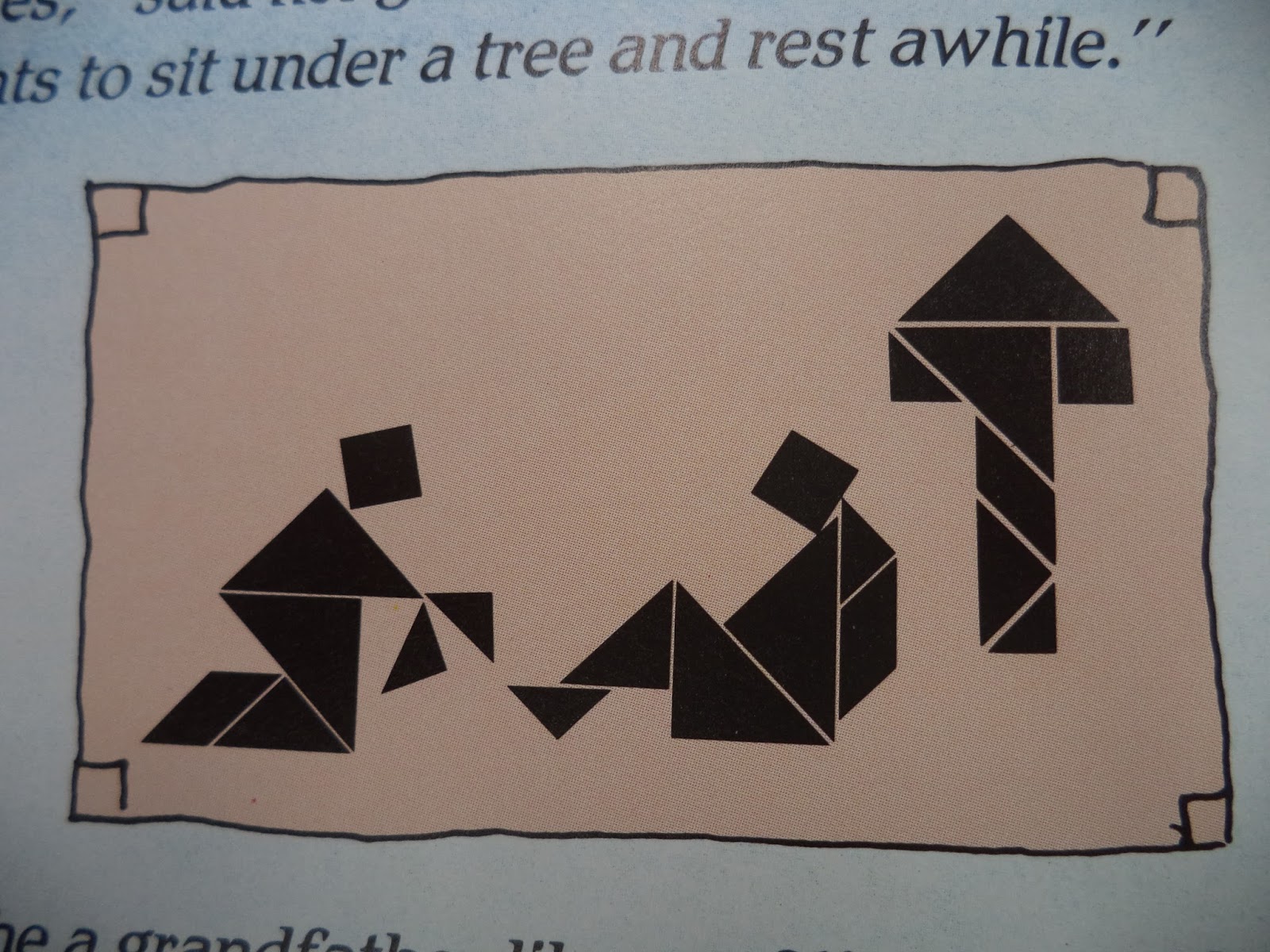
The grade math curriculum suggests using Tangrams and picture books when teaching 2-D shapes. (See below)


I've used these before, but this year I changed several of my resources and had a much more successful lesson.

Books

I used the books Grandfather Tang's Story and  Three Pigs, One Wolf, and Seven Magic Shapes


Pictures

I took close-up pictures of the templates used in each book, which I displayed on my SMART board.

Magnetic Tangrams

I have a set of large foam tangrams that I use to demonstrate with.  Before starting my lesson this time around, I hot-glued magnets to the back of each piece.  Now I can use them on my whiteboard as I demonstrate, which makes the demonstration visible for all students.


Both of these visuals added success to my lesson.  In the past, my students had to refer to tiny 3 cm square pictures, now the large image on the SMART board combined with my step-by-step demonstration on the whiteboard, enabled all of my students to build the shapes successfully!

Do you have other Tangram books or resources that you've found successful? 

Thursday, 1 October 2015

Figure Me Out Math Project


 Figure Me Out Poster

One of my first math activities for my grades 1 & 2 class this September was having them create "Figure Me Out" posters. There are several variations around, but I found mine at Shut the Door and Teach and adapted it for my class. 
  • They first answered the question on a BLM that I created. 
  • Next, we brainstormed for different ways to represent numbers: number word, tally marks, etc,. which I recorded on chart paper for the students to refer to when they created their posters.  
  • Then they looked at their answers and decided which number representation they will use for each one.  They recorded those on 8 cm x 8 cm sticky notes.  One the actually poster, they did not write any numbers, they had to decide how they would illustrate the question, e.g. What is your phone number, most decided to draw a phone.  
  • Finally they stuck their stickie notes on top of the matching illustration.
This poster idea is similar to the "Math About Me" ideas floating around on Pinterest, but I found this activity takes it a step further.  The following day, the piled up their stickies, reread their questions and re-positioned their stickies.  For some, that proved to be quite challenging.  Each student also tried to "Figure Out" several of the other students by answering their questions.


String Heights Graph

One of questions on their poster asked about the students' heights.  We decided to measure our heights using an idea from  Going back to Kinder
  • We measured string for their heights and taped the students' head shots on one end to create a graph.  
  • When we do graphing, I usually ask my students, "What does the data tell us?" and we create various statements about the information including comparison statements.  In this particular case, we had to refer back to the information on their BLMs and posters, since measuring with string isn't overly accurate and some string stretches, so students are able to increase their height if they are so inclined :)!


Who Lives at My House

Another question on their poster is about the number of people in their families.  I found a simple, but neat idea for this Family Glyph and want to credit the blogger, even though I wasn't able to visit the blog, but her picture is self-explanatory.
One of my university methods professors reminded us that "If you're just going to do a glyph to simply hang on the wall, you haven't done any math. That is just a glorified art project."  I don't even think it's art either. 
So, after completing the glyph, we all gather around in a circle on the floor, with the glyphs in the centre to do some logical thinking!  I start by giving clues about the information on the glyphs: I'm thinking about someone who has... at least one sister, a pet, etc.  Usually I try to make it so that just a few people are removed with each statement.  After a few goes, the students take turns giving clues. 

Birthday Board

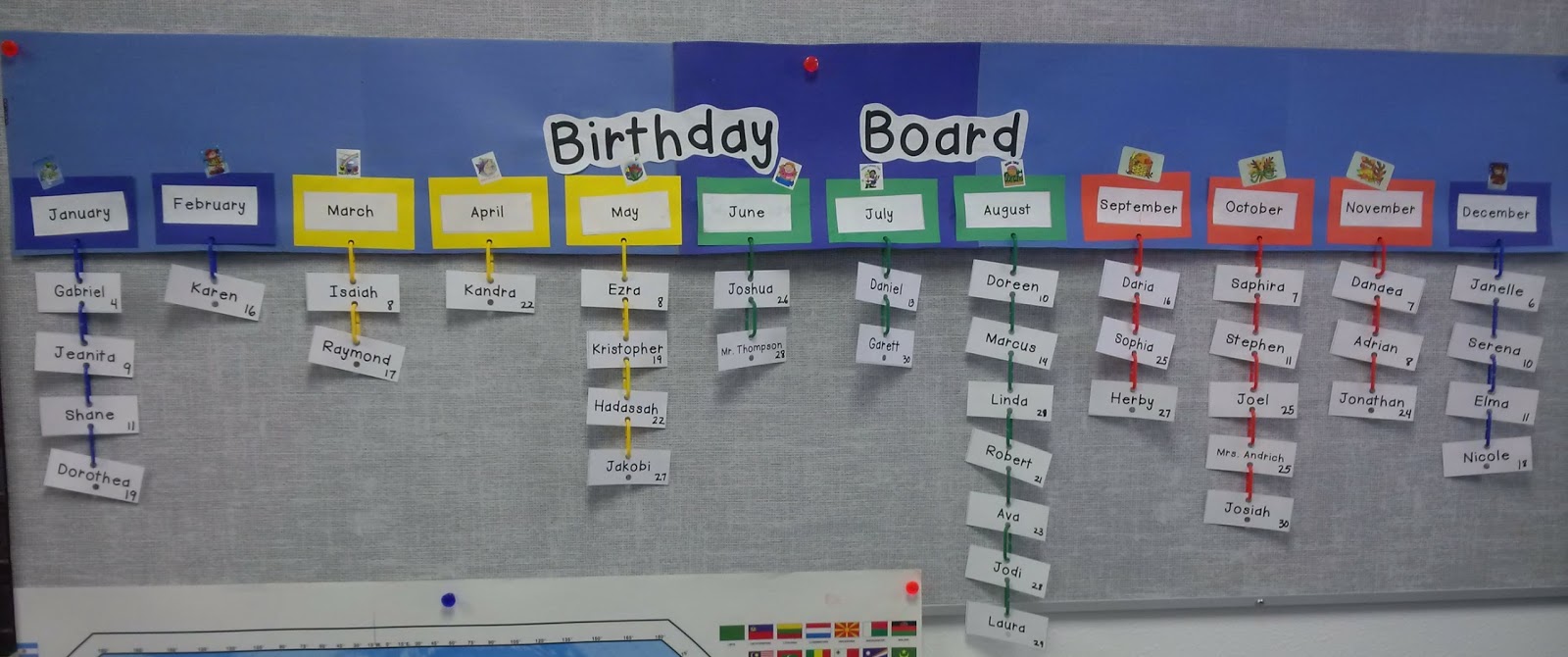
A third question on their poster asks about the students' birthdays.  I extending this section by creating a birthday board similar to the one I found at Etsy a while back.  Their's is made out of wood, while we made ours out of poster board and card stock.
  • I started by asking my students when their birthdays are and in what season they fall  in.  For most of the class, the latter was a new notion for them.  
  • We then looked at a twelve month calendar.  My students have agenda books, so we found a copy inside the front covers.  
  • We googled the first day of each season and proceeded to sort the months according to season.  Of course there is overlap, so for simplicity sake, I decided to start with the month the seasons start with and the following two months: e.g. spring - March, April and May.  
  • We colour-coded the month labels by gluing them to different coloured card stock, depending on the season. I printed the name of each students and staff member on white card stock.  
  • Next we added the birthdate to each name card and arranged the names below their corresponding month in numerical order.. We punched holes below each month label and above and below each name label, then attached the labels with plastic chain links.
We concluding the activity by filling in a BLM where students referred to the Birthday Board to answer questions regarding the months and seasons of our birthdays.

When reflecting on this personal identity project, I discovered we had worked on concepts in each math strand:
  • Number: counting, comparing and ordering numbers,
  • Patterns & Relations: repeating patterns
  • Shape & Space: months of the year
  • Statistics &Probability: gathering and recording data

In addition we touched on several social studies and science concepts:
  • Social Studies: similarities and differences
  • Science: four seasons
Sometimes items in a series of lessons seem to fall into place without too much effort and this was one of them!  It was great to have it develop into a learning experience that spans several different curriculum areas and more importantly, one where students are excited about the discoveries they make about themselves.

Thursday, 23 October 2014

What's in a Name?

Using name activities at the beginning of the school year is a great way to grab young learners' attention, as their names are so closely connected to them.  This year my home
room class consists of students in grades 1 & 2, and I found several math related name activities for the the start of the year. 


Place Value

My students built the first letter of their names with multi-link cubes.  I provided them with strips of 1" grid paper.  They copied their initial using the paper and numbered each square and circled each multiple of 10.  Since most of my students are in grade 1, circling the tens helped them see how many 10s and extra cubes they have.  Following that, they filled out a form which tells the number of tens, ones and the total number of squares needed to make their first initial. I adapted this idea from something I found at: Place Value.


Name Patterns

I gave each student a 5 X 8 grid and instructed them to write their names, one letter per square on the grid. Tracing each letter enabled them to see the patterns that can be found when they write their name in a grid.  Of course, the patterns will change depending on the size of the grid..  


 Graphing

We also created a bar graph to show comparisons on the number of letters in the students' first names.  Students then composed sentences that tell what the data on the graph tells us.  Some times the mentioned things like "Two of the children are Waldners," which is not evident on the graph.  We then had to discuss that whatever information we write down must be seen on the graph.  Next, the grade 2 students composed questions regarding the data on the graph which the grade 1 students had to answer.  


The stars on the graph indicate the 7 components that need to be included on each graph to make it complete.  I have a poster up for the students to refer to whenever they do any graphing activity. 


Saturday, 21 June 2014

Multiplication Table


In grade 3 students are required to"demonstrate and understanding of multiplication to 5 x 5 by representing and explaining multiplication using equal groups and arrays."


Multiplication Match

Typically when I teach this unit I have my students build arrays and match them with repeated addition and multiplication sentences.


Grid Paper Charts

 I've also had them create multiplication charts using grid paper.


Commercial Array Charts

Commercial array charts are available and since I have several in my classroom, I've cut one up for students to assemble. For some students building this array can be rather difficult.


 Area Blocks Chart

This year I added a stepping store between the matching activities and creating multiplication charts: I had my students first build the charts using area blocks and number cards.


When it came time for the students to create their own paper charts, it was apparent that first building the "area blocks" made this final step easier for some students.  After they finished gluing, I had them write the products on the green arrays.  One student quickly piped up, "I get the pattern. Row 1 is counting by 1s, row 2 by 2s and so on."
Always nice to hear kids verbalize that the "get it."


Monday, 24 February 2014

Math Racks

On January 27-28, 2014 Several Hutterite teachers (Sandra from Good Hope and Kathy from Odanah) and I had the opportunity to attend a fabulous math PD at Steinbach, MB.  Cathy Fosnot presented her Mathematics Contexts for Learning to us as well as her Year Long Resources.  All of us came away with a wealth of information, ideas and activities...
To teach early number sense, one of the resources Cathy uses is a Math Rack. Or should I say math racks as she uses three different ones, starting from the 5-bead rack, moving up to 10, then 20-bead rack.
Following is her Math Rack Progression:

5 Rack

  • quick images on part/whole

10 Rack

  • quick images of right side only, privileging the 5 structure 
  • combinations that make 10
  • compensations
  • showing part, determining what's hidden

20 Rack

  • quick image doubles, starting with 5 + 5 as a helper, privileging the 5/10 structure
  • quick  images doubles +/-
  • compensations
  • making tens
  • easy ones and hard ones
  • one addend shown, imaging the other
  • minuend shown, imaging the subtrahend
  • just written problems, imaging the rack


Each  participant also left the session with a 20-bead rack.  Since I wanted to start my class with a review of the 5 and 10 bead racks, I had some locally made.  My sister Sonia had purchased a beaded car seat some time ago, so my mom took it apart for me. Since I had taken a picture of the racks Cathy used for her demonstration.  I showed it to our mechanic and in short order he created 5 and 10 bead racks for me as well as rods for the 20 bead racks.  I took the rods over to our carpenter shop and tada! I had 20-bead racks.
Thanks Sonia, mom, Darren and Don for your contributions.  To quote a character in one of Cathy Fosnot's books, "A real community project!"

After a few 5-10 minute session, my kindergarten students are getting to be quite proficient with  the combinations of 5.  My grade ones are using to 10-Bead rack to learn facts of 10 and my third graders are working on facts beyond 10 with the 20-bead rack.  All told, I find the Math Racks to be very useful tools indeed!